Rare Disease & Resources
When a Baby Dies in Their Sleep, Can a Cause Still Be Found? On SIDS and SMARD1
August 15, 2026
 Tap the image to enlarge ↗
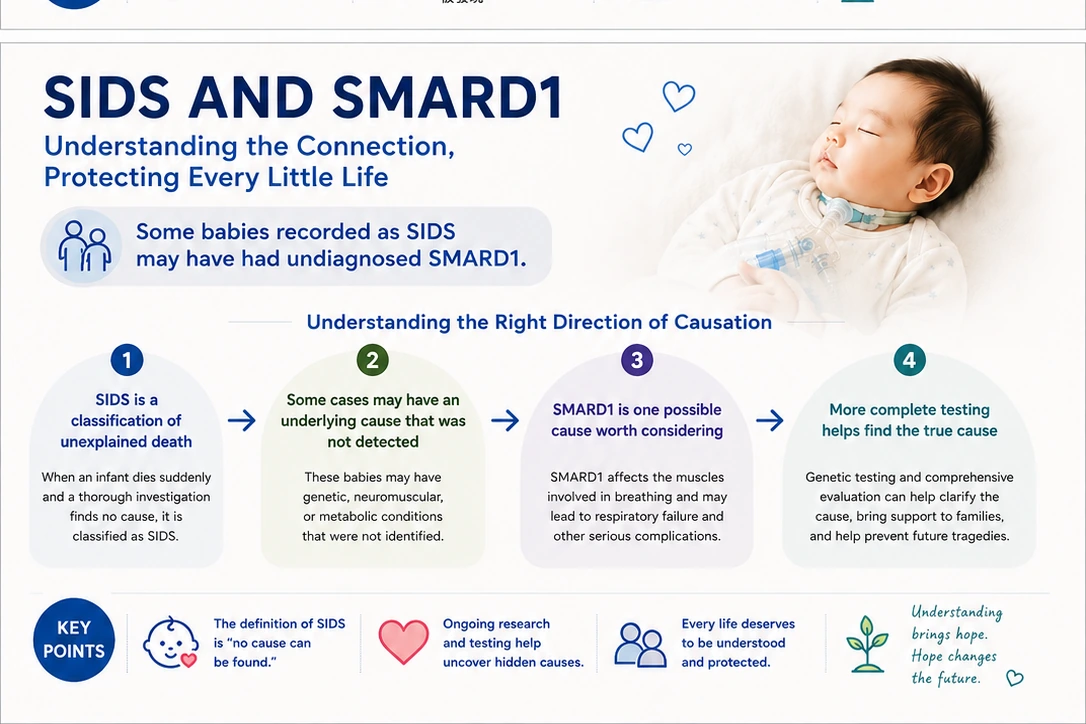
I often think about the babies who died while co-sleeping, or face-down in their sleep, and wonder how many of them had SMARD1.
Because the picture of sudden infant death — most often before six months of age, breathing stopping during sleep — looks so much like what happens when SMARD1 takes hold. Once it does, the lungs can collapse suddenly and a child can no longer breathe.
Those parents who have blamed themselves all these years for not watching closely enough may have been blaming the wrong thing entirely.
What happens when SMARD1 takes hold
SMARD1 affects the nerves that control breathing. When the diaphragm — the muscle we rely on most to draw breath — becomes weak or paralysed because the motor neurons supplying it are damaged, a child can suddenly become unable to breathe on their own.
Before that point, the signs can look like very little: breathing that seems slightly laboured, a weaker cry, tiring easily during feeds. In an infant, all of these are far too easy to read as normal. By the time it happens, it is often too late.
What the medical literature says
This is not only a family’s hunch. The research literature has raised the same possibility:
- Certain variants in the IGHMBP2 gene are considered a possible risk factor for sudden infant death syndrome.
- Respiratory arrest caused by SMARD1 may be mistaken for, or present like, sudden infant death.
One thing must be said plainly: “possible” is not the same as “is.” Sudden infant death syndrome is a diagnosis of exclusion — the label used when every known cause has been ruled out. More than one thing sits underneath it, and SMARD1 is only one of the possibilities that has been proposed. Without testing, no one can say that a particular child had SMARD1.
What many families do not know: testing is possible now
The common understanding used to be that genetic testing needed a living patient — that once a child was gone, the cause could never be found.
That is no longer true.
There is an approach called a molecular autopsy: DNA is extracted from the dried blood spot taken from a baby’s heel during newborn screening, and then sequenced. Almost every newborn has one of these cards taken in the first days of life — and it may still exist.
Researchers in Hong Kong have already run studies on sudden unexpected deaths in infancy and childhood, combining metabolic testing with genetic sequencing to find causes that were never identified during life.
In other words: the door you believed had closed for good may still be open.
How to ask
In Taiwan, newborn screening is handled by three screening centres:
- The Newborn Screening Center at National Taiwan University Hospital
- The Chinese Foundation of Health, Neonatal Screening Center
- The Taipei Institute of Pathology
Which one received your child’s card can usually be traced through the hospital where they were born, or the maternal health handbook.
Outside Taiwan, the equivalent question goes to whichever national or regional programme runs newborn screening where your child was born, or to the hospital that cared for them.
The questions to ask:
- Is my child’s dried blood spot still stored?
- Can the family request genetic testing on it, and what documentation is needed?
- If the card is gone, are any other samples retained — pathology slides, or specimens kept from a hospital admission?
One thing we have to be honest about: we could not find a clearly published official retention period for these cards in Taiwan, and practice may differ between centres. So the only way to get an answer is to ask directly — do not give up on the question because someone tells you the card was “surely destroyed by now.”
It is also worth booking an appointment with a genetic counselling clinic (most major medical centres have a genetics or medical genomics department). A genetic counsellor’s job is exactly this: helping a family decide whether to test, how to read the result, and how to face the questions that come after.
Three things to know before you go looking for answers
First, you may not find an answer. The card may no longer exist, and the testing may come back showing nothing. Go in prepared: this path does not guarantee a resolution at the end of it.
Second, if it does turn out to be SMARD1, that means both parents are carriers. SMARD1 is inherited in an autosomal recessive pattern: a child must inherit a changed copy of the gene from each parent to be affected. Carriers themselves are completely healthy, have no symptoms, and would never otherwise know.
That sentence carries weight, so let us be clear about it: this is nobody’s fault. Carrying a recessive variant is a matter of chance. Every person alive carries a number of them; almost everyone simply never meets a partner who happens to carry the same one. Nothing was done wrong here, and nothing could have been foreseen.
Third, this information affects future pregnancies. If both parents are confirmed carriers, every pregnancy carries a 25% chance of an affected child — and that figure does not change based on how previous pregnancies turned out. But once carrier status is known, options exist: prenatal diagnosis, embryo screening. Without knowing, there are none. This is precisely why it should be done with a genetic counsellor’s help, rather than alone with a report you are trying to interpret.
A closing note
If testing does confirm that a sudden infant death was caused by SMARD1, my hope is that those bereaved parents can stop asking themselves “was it because I didn’t watch him closely enough that night?”
Fate can be cruel, and some children stay in this world only briefly. My own son’s lung collapsed while he happened to be at the nurses’ station, and he was intubated in an emergency and brought back. It extended his life — and it also left a soul confined inside a paralysed body.
My hope is that medicine keeps moving forward: that SMARD1 testing can one day be added to prenatal screening, and that a treatment can be found, so that more children can be protected and helped.
Further reading: What is SMARD1? Symptoms, Inheritance and Treatment
Sources
- MedlinePlus Genetics — Spinal muscular atrophy with respiratory distress type 1
- Perego et al. (2020) — Current understanding of and emerging treatment options for SMARD1, Cell Mol Life Sci
- Dried Blood Spot Postmortem Metabolic Autopsy With Genotype Validation for Sudden Unexpected Deaths in Infancy and Childhood in Hong Kong
- The Genetics of Sudden Infant Death Syndrome — Towards a Gene Reference Resource
- Taiwan Health Promotion Administration — Newborn Screening
This article is an information summary, not medical advice, and it cannot determine the cause of death for any individual child. Please discuss any testing or decision with your own healthcare team and a qualified genetics professional.
Get in touch
Prefer to talk privately? Email us directly. Prefer to comment publicly or share? Find us on Facebook.
The content on this site is one family’s personal caregiving account, not medical advice. Please discuss any medical decisions with your own healthcare team.