Tracheostomy: Full Information
Tracheostomy Suctioning: Every Two Hours, and Every Hour When He's Sick
August 2, 2026
 Tap the image to enlarge ↗
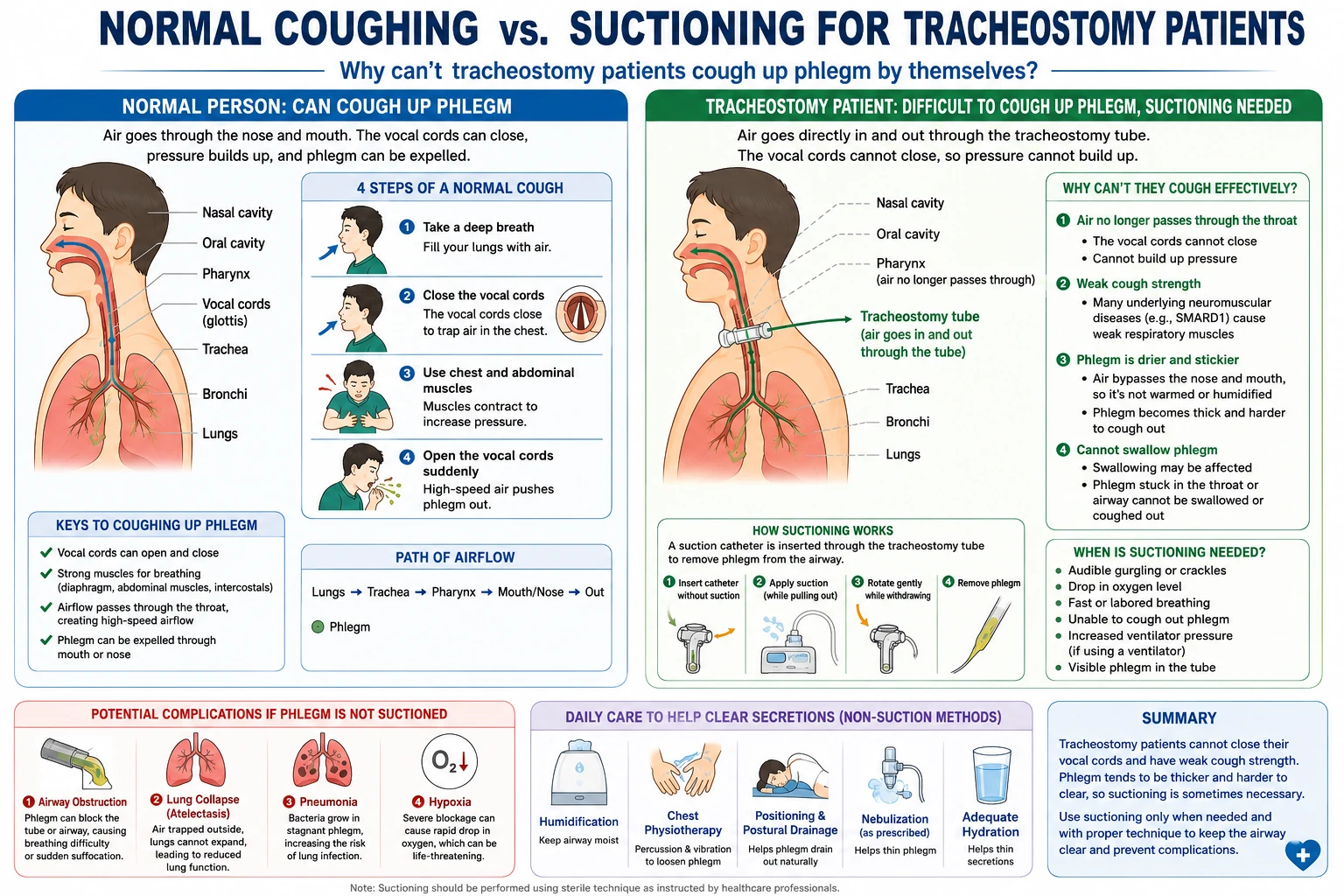
Before my son turned one, we opened the valve on his tracheostomy and suctioned out mucus and secretions almost every two to three hours. During the day, and through the night. When he caught a cold it got worse — sometimes once an hour, right around the clock. Suctioning hell.
Mucus blocks the tracheostomy tube or the bronchi, and air stops reaching the lungs. What follows is rapid breathing, falling oxygen saturation, and finally life-threatening hypoxia. So suctioning has no “I’m too tired tonight” option, and it cannot be put off — his oxygen is dropping, and his life is right there at the edge of the cliff.
Why is it so hard for a child with a tracheostomy to cough mucus up on their own? The main reason is that air no longer travels through the throat. It goes straight in and out through the tube in the neck. And children on a long-term tracheostomy usually have an underlying condition — a neuromuscular disease, a spinal cord injury, ALS, muscular dystrophy — which leaves the diaphragm, the abdominal muscles and the intercostal muscles without enough strength to push mucus out. Coughing looks like an instinct. It is actually an act of strength.
With my son’s SMARD1 — a rare form of spinal muscular atrophy that damages the nerves supplying the breathing muscles — the cough is very weak. Even when there is mucus, clearing it on his own is close to impossible.
Suctioning counts as an invasive procedure, which means only family can perform it. Even when you qualify for a home-care aide under Taiwan’s long-term care system, they are not permitted to suction for you. So the family never truly gets to rest. Someone has to stay beside him, always.
Once the tracheostomy happens, life turns upside down — for the patient and for the family. This is the most ordinary part of tracheostomy care. It is also the part almost nobody tells you about while you are still deciding whether to go ahead.
Get in touch
Prefer to talk privately? Email us directly. Prefer to comment publicly or share? Find us on Facebook.
The content on this site is one family’s personal caregiving account, not medical advice. Please discuss any medical decisions with your own healthcare team.